

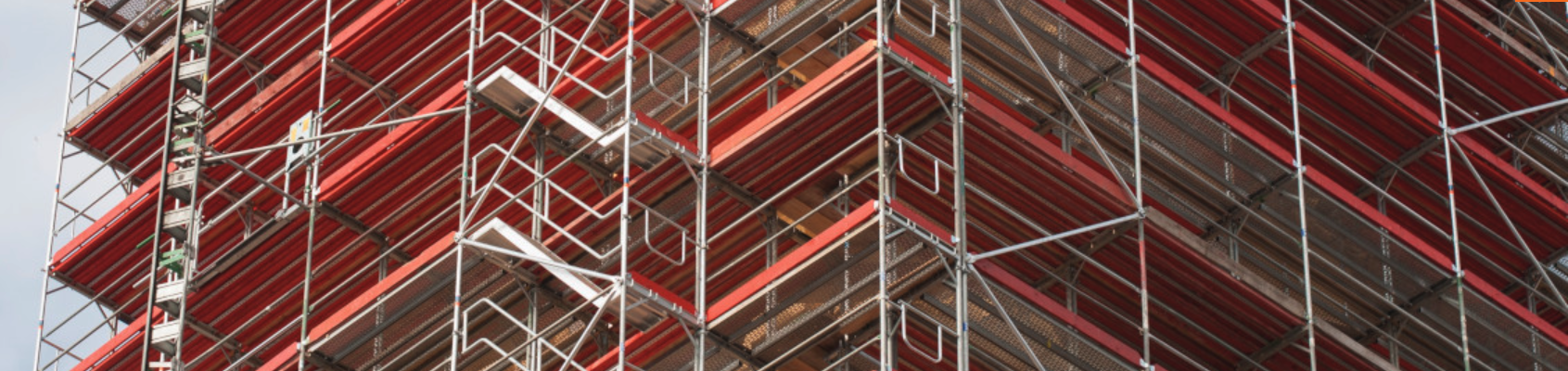
When scaffolding a building, pedestrian protection is essential to ensure the safety of pedestrians and passers-by. Construction work can be dangerous, both for the workers on the scaffolding and for people in the vicinity of the construction project. In this article, we will look at different types of pedestrian protection and explain why it is essential to prevent potential accidents and ensure public safety.
Why pedestrian protection is important
Before we look at the different types of pedestrian protection, let’s clarify why they are needed in the first place. Scaffolding is often erected on buildings to support construction workers and provide access to elevated areas. However, during this work, falling tools, materials or even debris can pose a risk to passers-by if adequate protection is not in place.
The use of pedestrian protection, especially when scaffolding a buildings in publicly accessible areas, contributes significantly to public safety. Pedestrians can feel safe walking through the scaffolding without having to worry about falling objects. At the same time, contractors who provide adequate pedestrian protection minimise their risk of liability and demonstrate their responsibility to the safety of the public.
What is pedestrian protection?
Pedestrian protection is a safety measure, particularly in public traffic areas, to protect you, pedestrians and passers-by from falling objects and other hazards during construction work. In particular, the risk of falling objects from scaffolding should not be underestimated, as even the smallest objects can pick up speed as they fall and cause serious injury.
This is one of the reasons why special use areas for scaffolding in public traffic areas are in most cases only allowed under certain conditions. Depending on local regulations, a special use permit or traffic order from the relevant authority may be required. When working in public traffic areas, the company carrying out the work may also be required to have a competent person on site with additional training in “securing work sites on roads”. This person is responsible for preparing, carrying out and supervising the work to ensure the safety of pedestrians and passers-by.
To protect pedestrians and passers-by from falling objects from scaffolding, there are two main methods:
- Safety on ground
- Safety from above
How to ensure safety on ground
Always start at ground level to ensure the safety of passers-by around scaffolding. With safety on ground, for example, barriers keep hazard zones clear so that passers-by cannot get close to falling objects or other hazards around the scaffold.
These barriers must be clearly visible both day and night. This can be achieved by using reflective tape or omnidirectional warning lights. The minimum height of the barriers and the spacing of their markings depend entirely on local regulations.
Not only objects falling from scaffolding, but also components of the scaffolding itself, such as unprotected protruding scaffolding tubes, pose a potential risk of injury to passers-by as they are easily overlooked. For this reason, scaffolding at ground level should always be fitted with end caps, stud caps and highly visible yellow foam protectors.
Special care should also be taken to avoid tripping hazards. Where necessary, a continuous handrail should be provided to further enhance the safety of passers-by. If the scaffold or protective walkway interferes with existing street lighting, additional lighting measures must be taken.
How to ensure safety from above
Once the safety measures on the ground have been ensured, it is also important to protect passers-by from above. This can be achieved with scaffolding nets and tarpaulins as well as toe boards, for example. While doing so, take care that the scaffolding tarpaulins and nets used do not cover or obstruct the scaffolding barriers so as not to impair visibility for passers-by.